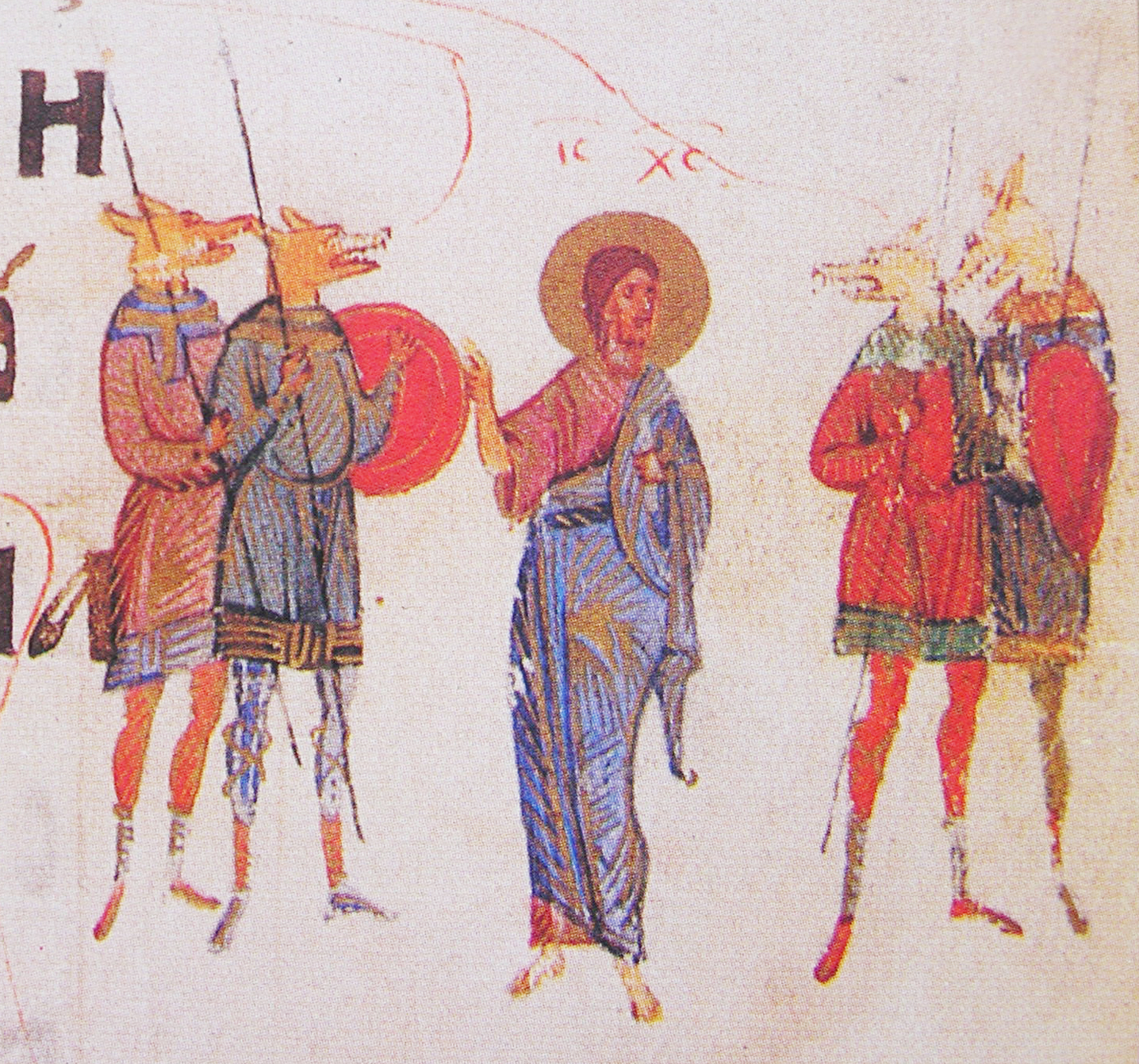
Often, Psoglav (a
creature in Slavic mythology with a dog head and a human body) was mistaken for
a giant. Konstantin Jiriček wrote that “among many medieval stories, there are
those which tell about giants who lived in caves, and their next of kin were
other giants with one eye and dog head”
In some Christian Orthodox
churches there are icons with Saint Christopher who has a head of a dog. One
such exists in the monastery in Sukovo, and there, they also call saint Christopher
the dogheaded saint or “psoglavi svetac”. (By the way, in the same monastery there
is a representation of Mary,
mother of Jesus,with wings.) One legend says that he, saint Christopher,
was actually Psoglav. when Roman army attacked one pack of psoglavs, they
captured one of them and sent him to Rome. There he was introduced to
christianity, and got the name Christopher. Later, because of his difficult
life, and painful death he was canonised.
To find out more about Psoglavs watch my video:
REFERENCES:
Out of the books I read to
prepare for this video the most helpful was Srpska mitologija u verovanju, običajima i ritualu (Serbian mythology)by Sreten Petrović
Humans tamed and domesticated wolves some 15000 or 20000 years ago. It is still relatively unclear why that happened, but it is clear that lead to appearance of our dogs.
Does that tell us that in every cute little puppy lies a dangerous wolf?
I made a list of 10 Serbian rare books, and talked a little about each one of them. I realize that I could have included some other books, but I made my selection based on the amount of information I could find on each book, and also on my opinion of how much they are important to Serbian literature and culture.
Miroslavljevo jevanđelje (Miroslav Gospel)
Vukanovo jevanđelje (Vukan Gospel)
Marijanino jevanđelje (The Codex
Marianus)
Istorija o žitija i slavnih djelah velikago
gosudarja i imperatora Petra Pervago (History and life of Peter The
Great), 1772. – Zaharije Orfelin
Srpske Narodne Pjesme (Serbian Folk Poems), 1814-1866 – Vuk Karadžić
Srpski rječnik (Serbian Dictionary), 1818. – Vuk Karadžić
Pismo Haralampiju (Letter to
Haralampije), 1783. – Dositej
Obradović
-Discourses of Collective Identity in Central and
Southeast Europe (1770-1945), Volume One: Late Enlightenment Emergence of the
Modern “National Idea”, Central European University Press, 2006.
Istorija
srpske ćirilice – Petar Đorđić, Zavod za udžbenike, Beograd, 1990.
Interesting fact about the Miroslav Gospel:
While visiting the Hilandar Monastery in winter of 1845/46, Archbishop Porfiry
saw the manuscript at the library of the monastery. Amazed at its magnificence,
he could not resist the temptation, cut out one leaf from the book and took it
away to Russia. This leaf was first shown at the exhibition in Kiev in 1874. In
1883 the leave came into the Imperial Public Library along with the material
gathered by Archbishop Porfiry Uspensky.
Interesting fact about Vuk Karadžić’s dictionary:
Jacobb Grimm was the one who actually asked Vuk to
put swear words in first edition of dictionary. In correspondence with Vuk he asked for their equivalent in German.
Interesting fact about Branko Radičević’s poetry:
Branko Radičević left
some unfinished work. He left at least one text meriting close attention in any
inquiry into Slavic Romantic irony, the ambitious unfinished poem of 1477
lines, composed in 1849, and featuring two titles: Ludi Branko (Branko
the Fool) and Bezimena (Unnamed). Seventy-four years later, literary
critics Pavle Popović and his brother Bogdan
Popović found that in this poetic fragment "there is no poetry
whatsoever" and that it "merits no compliment of any kind."
Comparisons with European phenomena lead Serbian intellectuals and publicists
such as Tihomir Ostojić, Ilija M. Petrović, Božidar Kovačević and Vladeta
Vuković to reduce it to an imitation or at best thorough influence of Byron. Only after the
centenary of Radičević's death, began the re-evaluation of Bezimena in
essays by Salko Nezečić, Ljubiša Rajković and others. Milan Dedinac and Miodrag
Popović, in his 1969 treatise, which is the first true scholarly study of the
fragment since Ostojić's monograph of 1918, both move Bezimena away from
Byron and Romanticism and toward Pushkin's Eugene
Onegin and Vissarion Belinsky's essay of 1843 about Pushkin
and Realism.